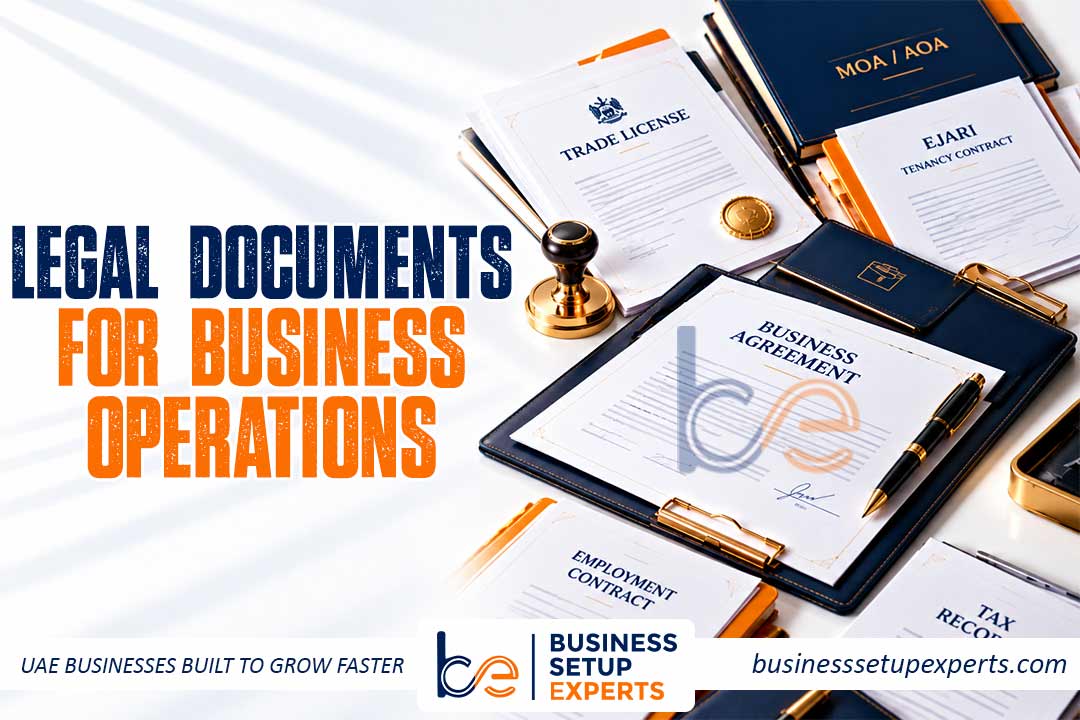
When you are planning to start a business in Dubai, important legal documents business Dubai should be ready in advance. These could include your trade name, business license, company records, contracts, tenancy documents, employee records and paperwork required by banks or government departments. If documents are needed in another country additional steps might be needed. The exact requirements will change based on your business activity, company type, registration location and the purpose of the documents.
What Are Legal Documents for a Dubai Business?
Think of documents as the written proof behind big business choices and connections. They can show who owns what let someone have the power to act write down an agreement or explain what needs to be done in a deal. Think of documents as the written proof, behind big business choices and connections. They can show who owns what let someone have the power to act write down an agreement or explain what needs to be done in a deal.
Some are prepared when the company is formed. Others are added along the way when you hire staff, sign a deal, bring in a supplier, or expand into a new market.
There is no single starter pack of documents for every Dubai company. A mainland LLC, a free zone company, and a branch can follow different procedures. UAE Government guidance covers steps such as choosing the activity and legal form, registering the trade name, obtaining initial approval, preparing an MOA when required, arranging a business location, and getting any extra approvals. The authority and the activity determine what ends up in your application.
Essential Legal Documents Business Dubai Companies May Need
1. Trade Licence
Keep the current trade licence where you can find it easily. It records the activity for which the company is licensed and may be needed when dealing with a bank, a government department, a contract, or a renewal.
2. Memorandum of Association (MOA)
MOA explains how the company is set up. MOA lists who owns the company and how shareholders work together. Only some types of companies need an MOA and its rules differ from one company to another.
3. Articles of Association (AOA)
AOA gives the rules for running. AOA covers who makes decisions how shareholders vote, how meetings happen and other inner workings. The exact rules vary based on the company type and its authority.
4. Shareholder or Partnership Agreement
Shareholder or Partnership Agreement helps clear up how things will be handled when two or more people own a business. Shareholder or Partnership Agreement talks about who does what how money is put in how decisions are taken how profits are split how shares can change hands. How disputes are solved. The document should fit the actual relationship rather than a situation copied from a template.
5. Board or Shareholder Resolutions
A resolution simply records a company decision. A bank or authority may ask for one when, for example, an authorised signatory is changed or a particular transaction is approved.
6. Power of Attorney (POA)
A Power of Attorney allows one person to act on behalf of another according to the limits of the document. The wording should match the job being handled. In some cases, the POA also has to be notarised or go through another formal step.
7. Commercial Lease and Ejari Records
Your premises can create another set of records. A business may need a lease or tenancy document for its office or approved location. For Dubai mainland businesses, UAE Government guidance refers to the need for a business location and the registration of Dubai tenancy contracts through Ejari.
8. Employment and HR Documents
Hiring staff means keeping the right employment and HR paperwork as well. The documents can vary with the employment arrangement and the rules in force at the time. If you have an old template sitting in a folder, check it before using it again.
9. Non-Disclosure Agreement (NDA)
An NDA is helpful when you need to share information but do not want it used or shared without permission. It can be used when talking with staff, contractors, suppliers, investors or business partners. The document should clearly state what information is considered confidential how it can be. Any situations where disclosure is allowed.
10. Client and Supplier Contracts
A written contract provides a record of what both the client and the supplier agreed on. It can include details about the work or goods being provided payment terms, delivery dates, warranties, liability limits how the agreement can end, confidentiality rules and how disputes will be handled. The final version of the contract should match the deal not just copy a standard template.
11. Invoices and Commercial Records
Keep all your records in one place. Documents such as quotes and invoices and purchase orders and receipts and other similar papers help show what was bought or sold. These records help with accounting and, with tax reporting. These documents need to be kept according to the rules that apply to your business.
12. Intellectual Property Documents
Intellectual property documents are important for some businesses more than others. This includes paperwork related to trademarks, copyrights, patents, licenses, assignments, software, content or any other protected asset. Making sure ownership and usage rights are clear, from the start can prevent problems later.
Which Documents Are Needed at Company Formation?
The formation file changes from one business to another. The government, structure, work being done people who own the company and the place where it operates can all influence the papers you need to give.
For a business in the mainland the papers might include an approval notice, rental agreements, a verified Memorandum of Association if needed additional permissions, for specific jobs and a service agent agreement if you’re using one. The United Arab Emirates government changed its rules in July 2026 so make sure to look at the list before you send anything.
You can review the current UAE mainland business setup requirements before preparing your final file.
Mainland vs Free Zone: Do Legal Documents Change?
Yes. The basic idea is similar, but the paperwork can change. The authority, legal entity, forms, approvals, and supporting documents are not necessarily the same.
Mainland Companies
A mainland company follows the rules of the relevant emirate and its activity. Its file may include the trade name, initial approval, constitutional documents, lease records, and additional approvals where the activity requires them.
Free Zone Companies
Free zone companies follow the rules of the free zone they choose. One zone may ask for different documents or offer different legal forms from another. The UAE Government advises investors to check the relevant free zone authority for its current company types and setup process.
For a current overview, see the official guidance on starting a business in a UAE free zone.
What Is Legal Document Drafting?
Legal document drafting turns a business arrangement into written terms. A document may set out rights, duties, conditions, authority, definitions, and signatures. For a company, this might mean an agreement, POA, resolution, NDA, service contract, or another business document.
A template can look fine at first glance and still miss something that matters to your situation. If an agreement deals with ownership, money, liability, or long-term commitments, a review by a qualified legal professional before signing can be a sensible step.
Document Legalization Services: When Do You Need Them?
Attestation or legalization is not part of every business document process. It usually comes up when the organisation receiving the document wants proof that it is authentic. That could be a government body, embassy, consulate, bank, court, or another institution.
The UAE Ministry of Foreign Affairs describes attestation as confirming the authenticity of signatures and seals on documents issued in or outside the UAE. The steps depend on the document, its place of issue, and where it will be used.
The current UAE Ministry of Foreign Affairs document attestation service explains the available digital and courier-based routes.
For commercial paperwork, MOFA lists documents such as contracts, commercial registrations, meeting minutes, trade licences, shareholder or partnership certificates, memoranda, tax certificates, branch records, financial statements, trademarks, patents, and commercial powers of attorney. The process still depends on the document and its intended use.
How to Legalize Documents in Dubai
The route starts with two simple questions: where was the document issued, and who needs it? The answer can change the steps. A process that works for one document or country may not work for another.
Step 1: Find out who will get the document and why it is needed.
Step 2: Make sure you know if you need the document a copy, a translation, a notarized version or an earlier authentication.
Step 3: Look at what the country or authority that issued the document requires.
Step 4: If needed finish any authentication or attestation steps in the country where the document was issued before it goes to the UAE.
Step 5: Send the document through the UAE attestation process or by going through the UAE embassy or consulate.
Step 6: Save the attested document and all the reference details in a place, for future use.
For eligible UAE-issued digital documents, MOFA currently offers Digital Attestation. The Ministry says eligible applications can be processed electronically, while other documents may use an approved courier route. The service page also states that the application determines the appropriate route based on the issuing authority and document type.
Legalization of Documents in Italian Embassy: What Should You Know?
If the document is going to be used in Italy, check the requirements of the Italian authority receiving it before you start. An embassy or consulate may be involved, but the sequence depends on the document, where it was issued, and what the receiving authority asks for.
Before submitting a document for legalization, confirm the receiving authority’s exact requirements. You may need authentication, UAE MOFA attestation, translation, or a consular step depending on the document and its intended use. The same principle applies to documents intended for other countries.
Notarization vs Attestation vs Legalization
These words are often used interchangeably in casual conversation, but they do not mean exactly the same thing.
Term |
Simple meaning |
| Notarization | A notary or authorised authority formally witnesses, certifies, or authenticates a document or signature under the applicable procedure. |
| Attestation | A competent authority confirms the authenticity of signatures, seals, or document status for the intended use. |
| Legalization | A document may pass through a chain of authentication and consular or diplomatic steps so it can be accepted in another country. |
If you need notarisation in Dubai, you can review BSE’s Notary Public Services in Dubai page for the documents and supporting information commonly requested.
When Should You Use a Legal Document Drafting Service?
Professional drafting is worth considering when a document could have a real effect on the business. That includes matters such as ownership, money, confidentiality, authority, liability, employment, intellectual property, or a long-term relationship.
Examples include a shareholder agreement for a multi-owner business, a commercial service agreement, a detailed NDA, a power of attorney, or a resolution connected to a major corporate action. The value is not simply making a document look formal. The wording should match the real arrangement and identify what happens if the relationship changes.
For legal advice or an opinion on enforceability, use a qualified UAE lawyer or legal consultant. Business setup and PRO support can help with administrative and government-facing processes, but that is not the same as providing legal advice.
Documents You May Need to Keep Updated
- Trade licence and company registration records
- MOA and other constitutional documents where applicable
- Shareholder, manager, and authorised-signatory records
- Board or shareholder resolutions
- Lease and Ejari records where applicable
- Employment and HR documentation
- Client, supplier, and service contracts
- Tax and accounting records
- Trademark and other intellectual property records
- Attested or legalised documents used for overseas procedures
Common Mistakes With Business Legal Documents
Mistake 1: Using one template for every business:
Different activities, structures, and transactions can require different wording and supporting documents.
Mistake 2: Signing before checking authority:
A document may need notarisation, attestation, translation, or a specific signatory before it can be used.
Mistake 3: Ignoring document expiry or renewal:
Some records need updating when licences, passports, leases, ownership, or company details change.
Mistake 4: Treating attestation as the same as legal advice:
Attestation confirms document authenticity within the relevant process; it does not replace legal review of the document’s terms.
Mistake 5: Assuming every foreign document follows the same route:
Country, document type, issuing authority, destination, and receiving organisation can change the required sequence.
Mistake 6: Keeping only scans when originals are required:
Some procedures require original documents or original digital documents with verification features.
How BSE Can Help With Business Documents in Dubai
Business paperwork can take longer than expected when several authorities are involved. Translation, notarisation, attestation, submissions, and follow-ups can all add another task to the list. At Business Setup Experts, we help with setup and PRO-related documentation so business owners have less of that administration to handle.
Our PRO Services in Dubai cover documentation, government procedures, licensing, visa and compliance support. We also provide document clearance services in Dubai for business and government paperwork. Where language is an issue, our legal translation services in Dubai can support document translation requirements. For attestation-related needs, see our attestation services in Dubai.
5 Things to Check Before You Submit a Legal Document
- Is the document type correct for the transaction?
- Are the names, passport details, company details, and dates accurate?
- Does the document need notarisation, translation, attestation, or legalisation?
- Is the signatory authorised to sign it?
- Does the receiving authority have any special format or validity requirements?
FAQs
Q1. What is a legal document?
A legal document is a formal record that creates, confirms, records, or supports a legal right, duty, relationship, transaction, or authority. In business, examples can include contracts, powers of attorney, resolutions, constitutional documents, and employment records.
Q2. Is a notarized document legal in court?
Notarisation can help authenticate a document or signature, but it does not automatically mean every term will be accepted or enforced in every dispute. The document, transaction, applicable law, and court or authority requirements still matter.
Q3. Is an MOU a legal document?
A memorandum of understanding can be a legal document, but its effect depends on its wording and the parties’ intention. Some MOUs are largely statements of intent, while specific clauses can create binding obligations.
Q4. What is legalization of documents?
Document legalization is a process used to authenticate a document so it can be accepted by an authority in another jurisdiction. The required steps vary by document, country, issuing authority, and destination.
Q5. Can BSE help legalize documents in Dubai?
BSE can assist with administrative and PRO-related document processes, including attestation, document clearance, consulate support, and legal translation. If a matter requires legal advice or an opinion on enforceability, a qualified UAE legal professional should be consulted.
Conclusion
Keeping the right legal documents in place is part of running a business responsibly in Dubai. A trade licence may be the document people notice first, but it is only one part of the wider business file. Depending on the company structure and activity, you may also deal with an MOA, constitutional records, shareholder arrangements, resolutions, powers of attorney, tenancy records, employment documents, commercial contracts, tax records, and intellectual property documents. For broader guidance, see our company formation in Dubai.
There is no single document checklist for every Dubai company. A mainland business may have different requirements from a free zone company, and a regulated activity may need extra approvals. A document intended for use outside the UAE can also follow a different authentication or attestation route. Before signing, submitting, translating, or legalizing a document, check what the receiving authority actually requires.
At Business Setup Experts, we help entrepreneurs and companies manage business setup and related documentation in Dubai. Our team can coordinate PRO procedures, document clearance, attestation, legal translation, and other administrative tasks. If you are not sure which documents you need, tell us your business activity, company structure, and what the document will be used for. We can help you work out the next administrative steps and identify the right authority when specialist legal advice is needed.
Good documentation is more than a complete file. It gives your company a clear record of ownership, authority, agreements, and approvals. It can also make dealings with government bodies, banks, partners, employees, and overseas authorities easier. Before starting a new transaction, check the document itself, the person signing it, the receiving authority, and any attestation or translation requirement. A little care at this stage can prevent unnecessary delays later.
Need help with the administrative side of your documents? Contact our support team on WhatsApp and tell us what document you need and where it will be used.