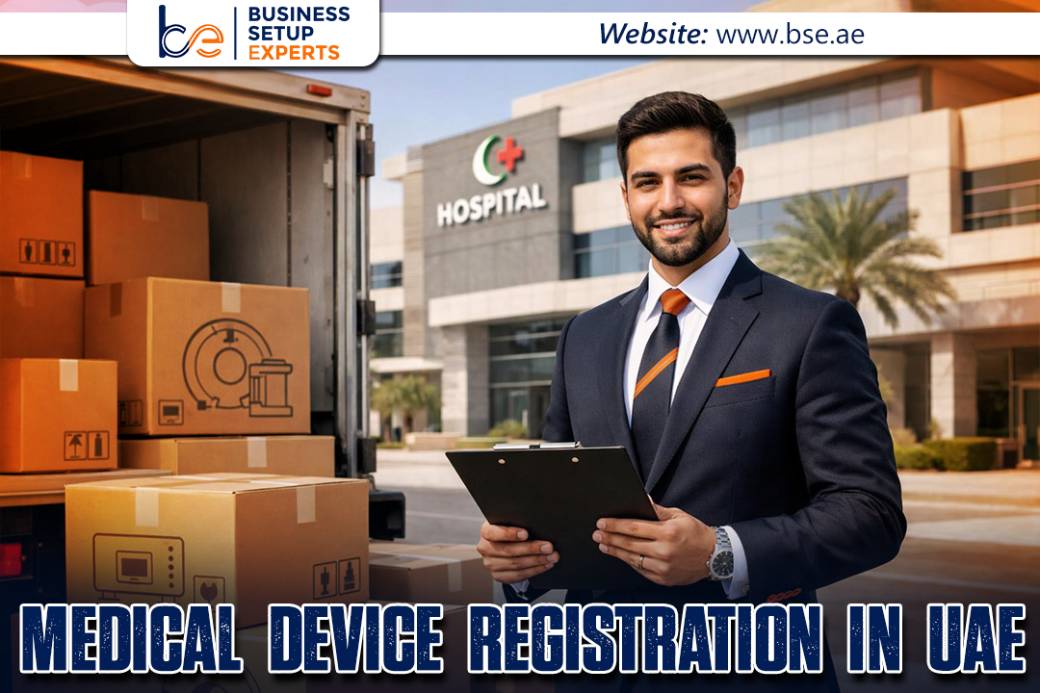
Medical Device Registration UAE is the federal regulatory process for obtaining marketing authorisation for a medical device intended for import and trade in the country. The current federal service is handled by the Emirates Drug Establishment (EDE).
This matters because many older articles still describe the process as a MOHAP registration. For a new application, the current EDE service should be the starting point. EDE now sets out the applicant conditions, supporting documents and requirements for medical-device marketing authorisation.
Registration is not the same as getting a trade licence or simply importing a shipment. The product needs the appropriate regulatory approval, and the applicant must meet EDE’s establishment and licensing requirements.
This guide explains the current process, documents, classification, fees and common issues. It also explains how the older UAE medical devices registration guideline and its annexes should be treated when researching the topic.
What Is Medical Device Registration in the UAE?
Medical device registration is the process used to obtain federal marketing authorisation for a medical device before it is imported and traded in the UAE through the applicable regulatory route. EDE describes its current service as registration of medical equipment for importing and trading in the UAE.
The approval is product-specific. It does not replace company licensing, warehouse or marketing-office licensing, customs procedures, healthcare-facility approvals or other permissions that may apply to the business.
EDE states that the marketing authorisation certificate is subject to the applicable validity and renewal requirements.
Who Handles Medical Device Registration UAE?
The current federal authority is the Emirates Drug Establishment. Its medical-device marketing-authorisation service identifies medical warehouses, local pharmaceutical manufacturers and marketing offices as target applicants.
EDE also states that Marketing Authorization Holder companies must be registered before they can register their products. The applicant must be an EDE-licensed medical warehouse or marketing office with a valid licence.
For a foreign manufacturer, this means the local regulatory structure should be settled before the product file is submitted. The manufacturer, UAE applicant and any authorised representative or agency arrangement should be checked against the current requirements.
Medical Device Classification in the UAE
Classification is one of the first technical decisions in a registration project. It affects the evidence and review route for the product. Older UAE material commonly uses Class I, IIa, IIb and III for medical devices, while some legacy documents and current EDE service material use broader Class I, II, III and IV references.
The correct class should be determined from the device’s intended purpose, risk and characteristics rather than its trade name. If classification is uncertain, resolve it before building the final dossier.
A wrong classification can lead to the wrong evidence package and additional questions during review. This is one reason a generic checklist should not be treated as a substitute for product-specific regulatory assessment.
What Is the UAE Medical Devices Registration Guideline?
The phrase “UAE medical devices registration guideline” often refers to the older Medical Device Registration Guideline published under the former MOH framework. Copies of that document are still widely available online and contain sections on registration files, classification, conformity assessment, product information and annexes.
That material can help explain the historical terminology, but it should not automatically be treated as the current application rule. Federal responsibilities and services have changed, and EDE now provides the live medical-device marketing-authorisation service.
The same caution applies to references to “Annex 2 (2.5).” Older guideline copies contain annexes dealing with essential requirements and related technical matters. Before using an old annex as a submission checklist, confirm the current EDE requirements for the specific device.
Documents Needed for Medical Device Registration UAE
EDE’s current service lists the following core documents and information. The final requirements can vary by device and classification.
- Completed registration application signed and stamped by the company.
- Valid registration certificate of the manufacturing factory.
- Certificate of free sale or registration from the competent authority in the country of origin, certified by the UAE Embassy.
- Product agency contract or authorised agency document.
- Quality-conformity or marketing-authorisation evidence, such as EC, 510(k) or PMA, according to the device classification.
- Post-marketing monitoring requirements and information.
- Product description, types, sizes, models, accessories, intended use, warnings, precautions and usage instructions.
- Packaging images, brochures and user manuals.
- Laboratory requirements or analysis information where applicable.
- Sample and certificate of analysis where required.
- Declaration that the device conforms to the applicable specifications.
- Safety and efficacy data for products where EDE requires it, including higher-risk devices.
EDE can request additional information. The list above should therefore be used as a starting point rather than a guarantee that every device needs exactly the same file.
Labelling and Instructions for Use
Labelling is part of the registration file. EDE asks applicants to provide product information, packaging images, brochures and usage manuals.
Older UAE guidance and industry sources often discuss Arabic labelling requirements. Because requirements can depend on the device and its regulatory route, the current EDE position should be checked before final artwork is printed.
The label, packaging, IFU and technical file should tell the same story. Product names, intended use, warnings, precautions and other claims should be consistent across the documents submitted for review.
How to Register a Medical Device in the UAE
The current EDE application is electronic. The online submission is relatively straightforward; the more demanding part is preparing a complete and consistent regulatory file.
Step 1: Confirm the device and its intended use.
Step 2: Determine the applicable classification and regulatory route.
Step 3: Confirm the Marketing Authorization Holder and EDE-licensed applicant structure.
Step 4: Collect manufacturer, free-sale, conformity and product documents.
Step 5: Prepare safety and efficacy evidence where required.
Step 6: Review labels, packaging and IFU for consistency with the technical file.
Step 7: Log in to the EDE portal, complete the application and attach the required documents.
Step 8: Respond to any EDE request for clarification or additional documents.
Step 9: Receive the marketing-authorisation certificate after approval.
How Much Does Medical Device Registration UAE Cost?
EDE applies separate fees for the application and medical device registration. These are regulatory fees for the product registration process and should not be treated as the full cost of entering the UAE market.
The overall budget can also include:
- EDE establishment or applicant licensing
- Medical warehouse or marketing office costs
- Document legalisation and certification
- Arabic or other required translations
- Regulatory consultancy
- Product testing or laboratory requirements, where applicable
- Local representation and other market-entry costs
Always check the latest EDE fee schedule before submitting an application.
How Long Does Registration Take?
The medical device registration process does not have one fixed timeline for every application. The overall period can vary based on the device classification, document readiness, technical review and any questions raised by EDE.
Applications may take longer when documents require correction, additional evidence is requested, or technical and regulatory issues need further review.
Applicants should therefore allow enough time for document preparation, submission, review and any required responses.
Does a Foreign Manufacturer Need a UAE Local Representative?
The UAE regulatory framework has long used local representation arrangements for foreign manufacturers. Current EDE requirements also require the appropriate UAE applicant and Marketing Authorization Holder structure before a product can be registered.
The exact legal and commercial role of a local representative, agent or Marketing Authorization Holder should be confirmed for the manufacturer’s specific situation. Older articles can describe arrangements that no longer apply in exactly the same way.
For a foreign manufacturer, resolving this point early helps clarify who submits the application, communicates with EDE and handles ongoing regulatory responsibilities.
What Happens After Registration?
Registration does not end the company’s regulatory responsibilities. EDE’s service includes post-marketing monitoring requirements, and the product may need renewal or variation when circumstances change. EDE has a separate renewal service for medical devices. Renewal remains subject to the applicable EDE requirements.
Companies should maintain appropriate records for complaints, safety matters, product changes and other post-market information required by the applicable regulatory framework.
Common Problems That Delay Registration
- Using an outdated MOHAP checklist without checking the current EDE service.
- Incorrect device classification.
- Missing or inconsistent technical documents.
- An improperly certified free-sale or registration certificate.
- Labels or IFUs that do not match the submitted product information.
- Unclear applicant, warehouse, marketing-office or Marketing Authorization Holder arrangements.
- Assuming every device needs the same evidence package.
- Treating the product-registration fee as the complete market-entry cost.
- Failing to plan for post-market monitoring and renewal.
Imported Medical Devices
Imported devices require careful coordination between the manufacturer, UAE applicant and regulatory file. EDE currently requires a valid free-sale or registration certificate from the competent authority in the country of origin, certified by the UAE Embassy.
The application also requires conformity or marketing-authorisation evidence such as EC, 510(k) or PMA according to the device classification. The supporting documents should describe the same product, manufacturer and intended use as the UAE application.
Before commercial shipments are arranged, confirm both the product’s UAE marketing authorisation and the licensing status of the importing establishment. Product approval and importer or establishment licensing are connected, but they are separate requirements.
Medical Devices Used by Clinics
A clinic should not assume that buying a device from a supplier automatically settles every regulatory issue. The product may need federal marketing authorisation, while the healthcare facility can have separate licensing, equipment and safety requirements.
Dubai Health Authority standards for non-surgical cosmetic procedures, for example, require relevant medical equipment and devices to be registered and approved under the applicable UAE medical-device framework. Additional controls can apply to radiation-emitting equipment.
Healthcare operators should therefore check both the federal status of the device and the requirements of the authority regulating their facility and procedure.
How Professional Support Can Help
Medical-device registration can involve technical documents, establishment licensing, government applications and supporting paperwork. Business Setup Experts can assist with relevant UAE administrative and government-service processes, while specialist regulatory professionals can address technical classification and compliance questions.
For related setup and government support, review Business Setup in Abu Dhabi or Documents Clearance Services.
For complex or higher-risk products, manufacturers should also use qualified regulatory professionals for classification, technical-file preparation and safety evidence.
Medical Device Registration UAE Checklist
- Confirm the product is within the applicable medical-device scope.
- Define the intended use and classification.
- Confirm the EDE applicant and Marketing Authorization Holder structure.
- Check manufacturer registration requirements.
- Obtain and certify the free-sale or registration certificate.
- Prepare conformity and market-authorisation evidence.
- Prepare product information, packaging, labels and IFU.
- Prepare safety and efficacy evidence where required.
- Check the dossier for consistency before submission.
- Submit through EDE and monitor regulatory requests.
- Plan for renewal, variations and ongoing regulatory requirements.
Before the FAQs
If your project also involves wider UAE business or government arrangements, you can review Golden Visa for managers for residency-related support and PRO Services in Abu Dhabi for government and administrative processing. These are separate from medical-device marketing authorisation, so their requirements should be checked independently.
FAQs
Q1. Who registers medical devices in the UAE?
The current federal marketing-authorisation service is handled by the Emirates Drug Establishment (EDE). The applicant and Marketing Authorization Holder must meet EDE’s establishment and licensing requirements.
Q2. How much does medical device registration cost in the UAE?
The cost depends on the applicable EDE registration fees and other market-entry expenses. These may include establishment licensing, document legalisation, translation, testing, regulatory support and local representation. Applicants should check the current EDE fee schedule before applying.
Q3. How long does Medical Device Registration UAE take?
The requirements can vary depending on the device, classification, completeness of the dossier, technical review and any additional information requested by EDE.
Q4. Is the old UAE medical devices registration guideline still useful?
Older guideline documents can help explain historical terminology and requirements, but a live application should be based on the current EDE service and applicable requirements. Old MOHAP-only information may not reflect the present authority structure.
Q5. How long is a UAE medical device marketing authorisation valid?
EDE states that medical-device marketing authorisation is subject to applicable renewal requirements.
Conclusion
Medical Device Registration UAE should be planned around the current Emirates Drug Establishment system rather than older MOHAP-only information. The authority, application route and regulatory responsibilities have changed, so a company preparing a new submission should start with the current EDE service.
The process begins with the product itself. Define the intended use, determine the appropriate classification and identify the evidence required for that device. At the same time, confirm the UAE applicant and Marketing Authorization Holder structure so the product file is being submitted through the correct regulatory setup.
EDE’s current application requires more than a registration form. Depending on the product, the file can include the manufacturing certificate, certified free-sale or registration evidence, agency documentation, conformity or marketing-authorisation evidence, product information, packaging, manuals and safety or efficacy information.
The work also continues after approval. Post-market monitoring, changes, complaints, renewals and other regulatory obligations can affect the product throughout its UAE market life. Good planning therefore covers both initial registration and ongoing compliance.
If you are preparing to enter the UAE market with a medical device, use the current EDE requirements as the starting point and build the dossier around the exact product. For related UAE business and administrative support, Business Setup can assist with relevant government processes, while specialist regulatory professionals can address technical compliance questions.
Contact our team on WhatsApp for UAE Medical Device Registration support.