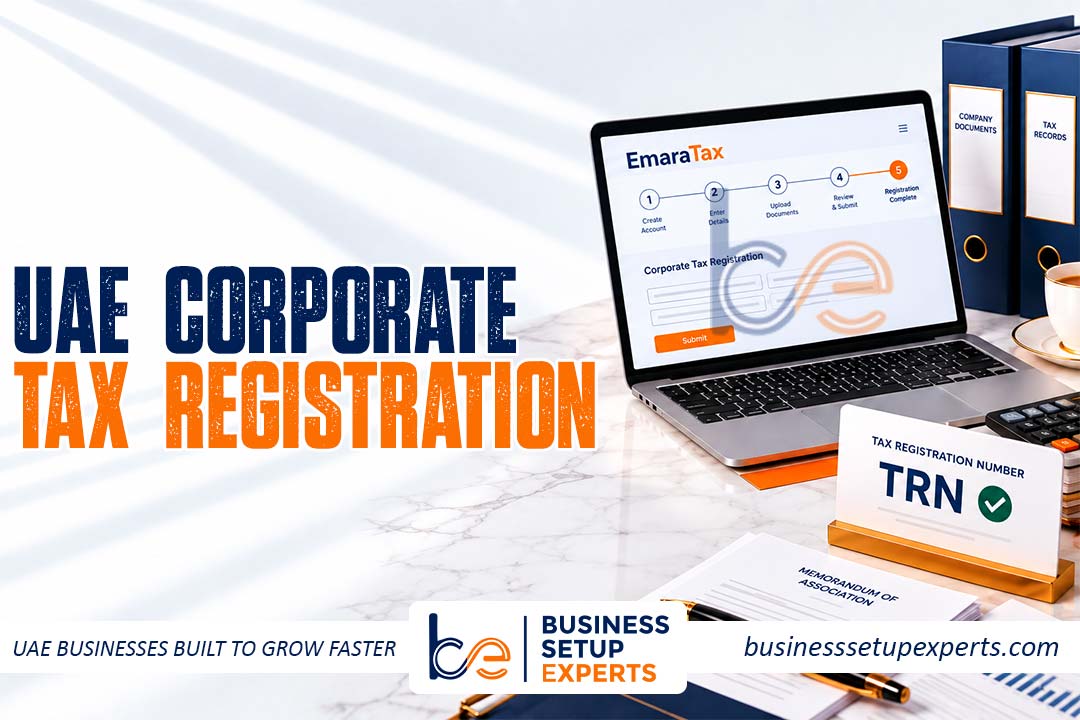
Registering with the Federal Tax Authority (FTA) gives a taxable person a Corporate Tax Registration Number. It also creates an official tax record. Registration is separate from paying tax. Businesses should understand their registration, tax, and filing obligations.
This UAE corporate tax registration guide explains who must register and how to apply through EmaraTax. It also covers required documents, registration deadlines, post-registration steps, and late registration rules.
Corporate tax registration deadlines have changed under FTA decisions. Businesses should check the latest FTA guidance for the deadline that applies to them.
What Is Corporate Tax in the UAE?
Corporate Tax is a federal tax on the taxable income of businesses and certain other persons in the UAE. It applies to tax periods starting on or after 1 June 2023. The tax is calculated on taxable income rather than simply on a company’s total sales or revenue.
For most taxable persons, the standard rate is 0% on taxable income up to AED 375,000 and 9% on the portion above AED 375,000. Qualifying Free Zone Persons follow a separate regime: qualifying income can be subject to 0%, while taxable income that does not qualify is subject to 9%. Being located in a free zone does not by itself mean that all income is taxed at 0%.
Who Needs Corporate Tax Registration in the UAE?
The FTA states that all taxable persons are required to register for UAE Corporate Tax and obtain a Corporate Tax Registration Number, subject to the rules and implementing decisions. The FTA may also require certain exempt persons to register.
- UAE resident juridical persons that are subject to Corporate Tax.
- Certain non-resident juridical persons with a Permanent Establishment or UAE nexus that brings them within the Corporate Tax rules.
- Natural persons conducting a business or business activity in the UAE when their annual business revenue exceeds AED 1 million.
- Certain exempt persons when the FTA requires registration under the applicable rules.
A salary, private investment income and real estate investment income are excluded from the AED 1 million business-revenue test for a natural person, according to the FTA’s current registration service. Businesses should therefore look at the nature of their income, not just the amount appearing in a bank account.
Corporate Tax Registration UAE: Is It the Same as VAT Registration?
No. Corporate tax and VAT are different taxes and each have their own rules about registration. VAT registration is generally to do with taxable supplies and imports and has its own thresholds. Corporate Tax registration is based on whether the person falls within the Corporate Tax registration rules.
A company can therefore have a Corporate Tax registration requirement even if it is not registered for VAT. The two registrations should be reviewed separately rather than treated as one tax process.
Corporate Tax Registration Deadline UAE
The corporate tax registration deadline UAE businesses face depends on the type of taxable person and the applicable FTA decision. It is not safe to use one date for every company.
For resident juridical persons incorporated, established or otherwise recognised before 1 March 2024, the FTA introduced deadlines linked to the month in which the person’s licence was originally issued. For resident juridical persons incorporated, established or recognised on or after 1 March 2024, the registration application is generally due within three months from the date of incorporation, establishment or recognition under the applicable timeline rules.
Multiple-licence businesses need particular care. Under the FTA’s earlier clarification, the earliest licence issuance date was used for the registration timeline for relevant resident juridical persons. Since the FTA issued a new Decision No. 12 of 2026 on registration and deregistration timelines, businesses should check the latest decision and their exact circumstances before relying on an older deadline table.
For the latest rules, review the FTA’s Corporate Tax legislation and decisions rather than relying on an old deadline chart.
Corporate Tax Registration Last Date: Why You Should Check Your Licence Date
The corporate tax registration last date search result often shows a single date. In reality, the relevant date may depend on the category of the taxpayer, the incorporation or recognition date, licence information and other conditions.
If you are running a company in Dubai, check the original licence details and the date the entity was established or recognized. Keep a copy of the licence and company documents used at registration as well. This gives you a clear record when checking the applicable registration timeline.
How to Register for Corporate Tax in the UAE
The FTA provides Corporate Tax registration through the EmaraTax platform. The current FTA service describes the application as a digital process and provides these main steps:
Step 1: Create or access your EmaraTax account.
Step 2: Create a New Taxable Person Profile.
Step 3: Open the Taxable Person Account.
Step 4: Use the Corporate Tax Action menu and select Register.
Step 5: Enter the required business and tax information.
Step 6: Upload the supporting documents requested by the FTA.
Step 7: Review the application carefully.
Step 8: Submit the registration request for FTA review.
The FTA currently estimates about 25 minutes to submit the Corporate Tax registration application. That is the estimated submission time shown on the service page, not a guarantee of approval time.
Documents Needed for Corporate Tax Registration
The documents depend on the legal form and taxpayer category. For a typical UAE company, the FTA can require documents such as:
- Valid Trade Licence or Business Licence.
- Certificate of Incorporation, Memorandum of Association or Partnership Agreement, where applicable.
- Passport and Emirates ID of the authorised signatory.
- Proof that the authorised signatory is authorised to act for the company, such as a relevant authorisation document.
- Corporate or ownership information requested in the application.
- Additional documents where the entity’s circumstances require them.
The FTA has also stressed the need for accurate information in the application. Company ownership percentages, incorporation information and the relevant tax period should match the supporting corporate records. Uploading a document is not enough if the information in the application does not agree with the company’s actual records.
Corporate Tax Registration Through EmaraTax
EmaraTax is the FTA’s online platform for tax services. Corporate Tax registration, filing and other tax-related services are handled digitally through the platform.
Before starting the application, make sure the authorised person has access to the company’s current documents and the information needed to complete the profile. A short document check before opening the application can reduce the chance of stopping midway because a licence, identity document or authorisation record is missing.
What Happens After Corporate Tax Registration?
After registration, the company should keep its Corporate Tax Registration Number and registration details with its core tax records. Registration is followed by ongoing compliance responsibilities where applicable.
- Maintain accounting and financial records that support the tax return.
- Determine taxable income for each tax period.
- Check whether any available relief, exemption or special regime applies.
- Prepare and submit the Corporate Tax Return within the legal timeframe.
- Pay Corporate Tax due within the applicable deadline.
- Update the FTA when registered information changes where an update is required.
- Keep relevant tax records for the required retention period.
The FTA states that taxable persons generally have no more than nine months from the end of each Tax Period to submit the Corporate Tax Return and pay the Corporate Tax due. The exact filing date depends on the company’s Tax Period.
Corporate Tax Registration and Free Zone Companies
Free zone businesses should not assume that a free zone licence removes the need for Corporate Tax registration. A Free Zone Person can still be within the Corporate Tax system and may need to register.
A Qualifying Free Zone Person can receive a 0% rate on Qualifying Income if it meets the conditions. Income that does not qualify can be subject to the standard 9% rate. The business therefore needs to consider both registration and whether its income qualifies for the special Free Zone treatment.
Late Corporate Tax Registration: Penalty and Waiver
The FTA currently states that an administrative penalty of AED 10,000 applies for late Corporate Tax registration. Businesses should not assume that the penalty replaces the registration requirement; the registration obligation still needs to be addressed.
The FTA also has a Corporate Tax late-registration penalty waiver initiative. Under the current FTA service information, the waiver can apply when the taxable person submits its first Tax Return, or the required annual declaration for an exempt person, within seven months from the end of its first Tax Period, subject to the initiative’s conditions.
This should be checked against the current FTA terms before relying on the waiver. It is better to register on time than to plan around a penalty waiver.
Common Corporate Tax Registration Mistakes
- Using an old corporate tax registration deadline without checking the latest FTA decision.
- Confusing Corporate Tax registration with VAT registration.
- Entering ownership or incorporation information that does not match the company’s records.
- Uploading expired or incomplete supporting documents.
- Assuming that a free zone company does not need Corporate Tax registration.
- Waiting until the last day to submit the application.
- Treating registration as the end of the tax process and overlooking return filing and payment obligations.
- Assuming that registration automatically means Corporate Tax is payable on all business revenue.
A Simple Corporate Tax Compliance Checklist
- Confirm whether the business is a taxable person.
- Identify the applicable registration timeline.
- Check the company’s licence and incorporation details.
- Prepare the required identity and corporate documents.
- Create or update the EmaraTax profile.
- Submit the Corporate Tax registration application.
- Save the Corporate Tax Registration Number and approval records.
- Set reminders for the Tax Return and payment deadline.
- Maintain accounting records throughout the year.
How BSE Can Help
Corporate Tax registration is easier when the company information, licence records and tax details are organised before the application starts. Our team can help businesses understand the registration process, coordinate documents and connect the registration work with wider accounting and compliance needs. If you need ongoing financial support, explore our accounting services in Dubai for help with accounting and related compliance work. If you are starting a new company, our business setup in Dubai service can help you plan the setup alongside your tax obligations.
You can also contact our support team on WhatsApp to discuss your business activity and current Corporate Tax registration position.
Frequently Asked Questions
Q1. Who needs Corporate Tax registration in the UAE?
All taxable persons subject to UAE Corporate Tax must register and obtain a Corporate Tax Registration Number. The FTA may also require certain exempt persons to register. Natural persons conducting business generally need to register when business revenue exceeds AED 1 million in a calendar year, subject to the applicable rules.
Q2. What is the Corporate Tax registration deadline in the UAE?
There is not one deadline for every taxpayer. The applicable date depends on the person’s category and the registration timeline rules. Resident juridical persons can have deadlines linked to their licence or incorporation/recognition date, so the current FTA decision should be checked for the specific business.
Q3. How do I register for Corporate Tax in the UAE?
Registration is completed through the FTA’s EmaraTax platform. You create or access an account, create the taxable person profile, open the Taxable Person Account, select Corporate Tax registration, enter the required information, upload documents and submit the application.
Q4. What is the penalty for late Corporate Tax registration?
The FTA currently states that the administrative penalty for late Corporate Tax registration is AED 10,000. A penalty-waiver initiative may apply in qualifying circumstances, subject to its current conditions.
Q5. Does a free zone company need Corporate Tax registration?
A free zone company can still be a Corporate Tax person and may need to register. Qualifying Free Zone Persons can receive a 0% rate on qualifying income if they meet the relevant conditions, but registration and tax treatment should be considered separately.
Conclusion
Corporate Tax registration is now a normal part of running a business in the UAE. The first step is not to look for a single registration date or assume that every company follows the same rule. You need to identify the type of taxpayer, check the relevant FTA timeline and make sure the company’s licence, incorporation details and ownership information are accurate. A small mistake at the registration stage can create extra work later.
The registration process itself is handled through EmaraTax. Before starting, keep the trade licence, incorporation or partnership documents, authorised signatory information and proof of authority ready. Once the application is submitted and the Corporate Tax Registration Number is issued, the business should keep the registration record with its tax and accounting files. Registration is only one part of compliance. The company may also need to prepare tax returns, calculate taxable income, pay any Corporate Tax due and keep supporting records.
One area that needs special attention is the corporate tax registration deadline. The applicable deadline can depend on the taxpayer’s category, licence details and incorporation or recognition date. The FTA has also issued newer registration and deregistration decisions, so an older deadline table may not reflect the current position. Businesses should check the latest FTA rules before relying on a date found in an older article or social media post.
Free zone companies should take the same approach. A free zone licence does not automatically remove the need for Corporate Tax registration. A Qualifying Free Zone Person may receive a 0% rate on qualifying income if it meets the relevant conditions, while other taxable income can be subject to 9%. This makes it important to separate the question of registration from the question of how a company’s income will be taxed. If you are setting up a new company, already operating in Dubai, or unsure about your registration timeline, we can help you organise the next steps. Our team can support document preparation, registration coordination and related accounting work. You can also review your wider business setup and tax requirements together instead of handling each task separately.